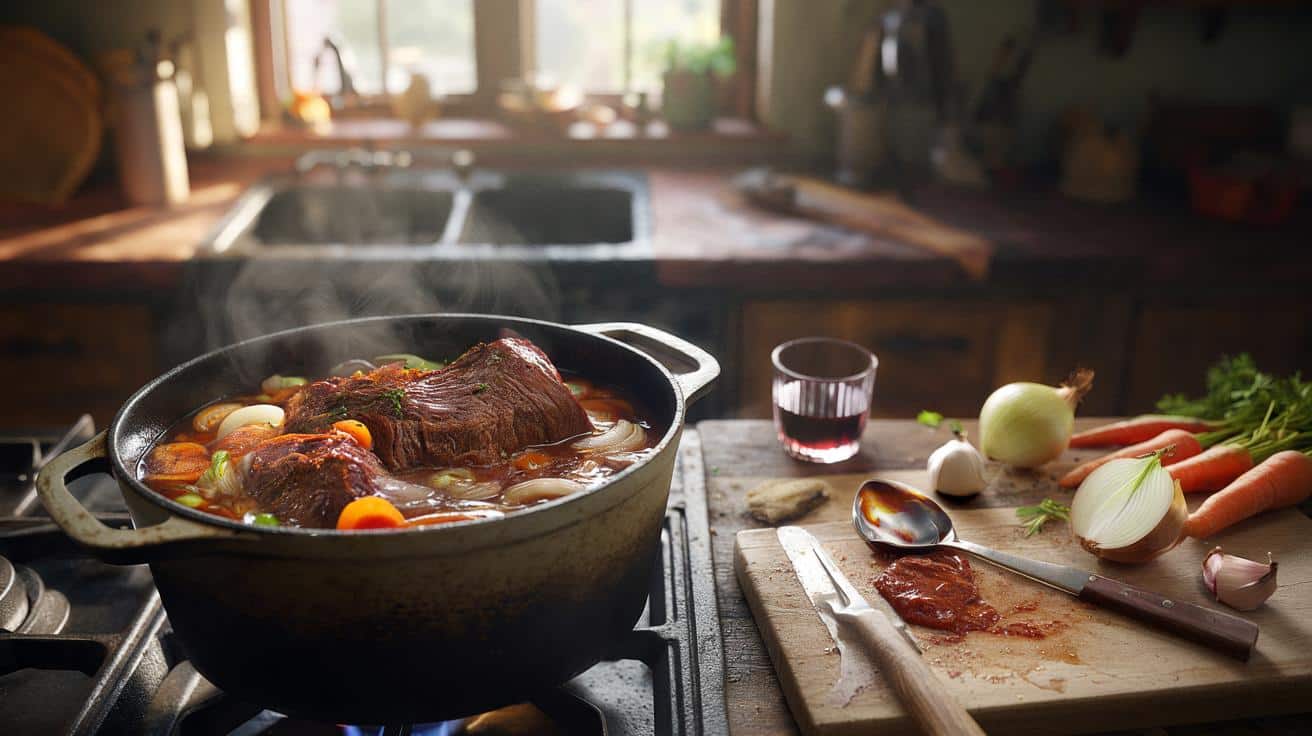
The first time I understood what “slow-cooked flavor” meant, I was standing in a quiet kitchen at 10 a.m., and dinner already smelled like it had a story. The windows were fogged, the radio was mumbling some old song, and on the counter sat a cheap cut of beef that looked like nothing special. I browned it in a heavy pot, tossed in an onion, a lazy splash of red wine, a few garlic cloves I didn’t bother to mince properly.
By noon, the whole apartment smelled like a family gathering I hadn’t invited yet.
By 6 p.m., that same humble piece of meat had turned into something you could cut with a spoon.
Time had done what money alone can’t.
This slow-cooked recipe doesn’t just feed you. It quietly rearranges your entire day.
Why time might be the best secret ingredient you’re not using
Most recipes promise speed. Ten minutes, fifteen minutes, “dinner in under 30.” They sound good when you’re tired and hungry and scrolling on your phone at 6:23 p.m., wondering what on earth to cook. But the dishes that people remember, the ones that make friends lean back in their chairs and close their eyes for a second, almost never come from a stopwatch.
They come from low heat, long cooking, and a kind of patient neglect.
Slow-cooked recipes turn cheap cuts into soft treasures, simple vegetables into something deep and almost smoky. They taste like effort, even when the work was mostly waiting.
Picture this. Sunday morning, you toss into a pot: a rough-cut onion, a few carrots, a celery stalk you were about to throw away, and some beef chuck on sale. A spoon of tomato paste, a dash of soy sauce, some herbs you find at the back of the cupboard, maybe a bay leaf if you’re lucky. You pour in enough broth or water to half-cover everything, bring it to a simmer, then lower the flame until the bubbles barely move.
You walk away.
➡️ Gardeners who leave small imperfections see fewer long-term problems
➡️ “I felt restless after sitting all day”: the signal I ignored for too long
➡️ This financial habit helped me feel in control even during uncertain months
➡️ This simple savory bake delivers deep flavor with minimal effort
➡️ This slow oven-baked dish fills the house with the most comforting smell
➡️ People who feel uneasy being taken care of often value independence deeply
➡️ “I cleaned my house thoroughly but forgot the one thing guests notice”
➡️ This planting depth mistake silently limits root expansion in most home gardens
You do laundry, answer emails, scroll, nap, live your life.
Four or five hours later, you lift the lid. The meat has collapsed into silky strands, the vegetables have melted into the sauce, and the whole pot smells like a restaurant kitchen at its best moment. Nothing fancy. Just time and heat, quietly working while you were busy.
The science is pretty simple. Those tough, connective tissues in cheaper cuts of meat? They’re full of collagen. At high heat and short cooking times, they stay chewy and rubbery. Give them low heat and several hours, and that collagen slowly breaks down into gelatin, turning the cooking liquid rich, glossy, and deeply satisfying.
Vegetables do their own quiet magic. Onions caramelize, carrots sweeten, tomatoes mellow, spices blend together. Flavors that were sharp or separate at the start melt into one unified note.
That’s the real trick behind this slow-cooked recipe idea: you’re not just cooking ingredients. You’re giving them time to talk to each other.
The slow-cooked base recipe that never fails you
Here’s the core method. You can apply it to beef, pork shoulder, lamb shanks, or even a fully vegetable version with beans and mushrooms.
Start with a heavy pot or Dutch oven. Heat a bit of oil until it shimmers. Salt your meat aggressively, then brown it on all sides until it’s deeply colored. Don’t rush this step. Those brown bits at the bottom are flavor gold.
Remove the meat. In the same pot, toss in chopped onion, carrot, and celery. Let them soften and color slightly. Add garlic, tomato paste, maybe a pinch of smoked paprika or cumin. Deglaze with wine, beer, or a splash of vinegar and water, scraping the bottom.
Put the meat back, pour in broth or water almost halfway up, bring to a soft simmer, then cover and drop the heat low. Let it barely bubble for 3–6 hours.
Most of us have sabotaged a slow-cooked dish at least once. Too much liquid, the flavor gets thin. Too high heat, the meat tightens instead of relaxing. Constantly lifting the lid to “check” on it, and losing all the gentle, trapped steam.
The comforting part: this recipe is oddly forgiving. If you forget it for an extra hour, it rarely punishes you. If your cut of meat is a bit lean, you can rescue it with a splash of olive oil or a knob of butter at the end. The biggest real mistake is impatience — cutting into it after 90 minutes and deciding it’s a failure.
Tough meat that’s been cooking for too little time just tastes like a bad decision. The same meat, two hours later, tastes like you knew exactly what you were doing all along. *The line between disaster and “wow” is often just… one more hour.*
Sometimes, watching the pot slowly exhale little waves of steam, you realize this kind of recipe isn’t really about cooking at all. It’s about allowing something to happen without controlling every second of it.
- Start with browning – That first deep color on the meat and vegetables builds a base you can’t fake later.
- Use what you have – Cheap wine, aging carrots, leftover herbs, even a spoon of marmalade can add complexity.
- Keep the heat low – You want a lazy, barely-there simmer, not a rolling boil.
- Season at the end – Flavors concentrate as they reduce, so adjust salt and acid only when it’s done.
- Let it rest – Turn off the heat and let the pot sit for 15–20 minutes; the sauce thickens, the flavors relax.
When a pot on the stove quietly changes the whole day
There’s a subtle side effect to this kind of cooking that nobody mentions on recipe blogs. When you put a slow-cooked recipe on in the late morning or early afternoon, your whole day tilts around it.
You move through your tasks with that background aroma following you from room to room. Time stops being this enemy on your shoulder (“You’re late, you’re behind”) and becomes something working on your side. While you’re busy replying to messages or helping with homework, the pot is quietly making you look like a better cook than you feel.
Let’s be honest: nobody really does this every single day. That’s not the point. The point is having one recipe in your pocket that uses time as an ally, not a threat.
| Key point | Detail | Value for the reader |
|---|---|---|
| Slow heat transforms cheap cuts | Collagen breaks down into gelatin over several hours, turning tough meat silky | Saves money while delivering restaurant-level texture and richness |
| Browning and deglazing are non-negotiable | Color the meat and vegetables first, then scrape the fond with liquid | Creates deep, layered flavor from basic ingredients |
| Time does the heavy lifting | Minimal hands-on work, long unattended simmering | Fits real life: you can work, rest, or go out while flavor develops |
FAQ:
- Question 1Can I turn this into a slow-cooker or Instant Pot recipe?Yes. For a slow-cooker, do the browning in a pan first, then transfer everything and cook on low for 7–9 hours. For a pressure cooker, brown directly in the pot, then cook under pressure for about 45–60 minutes, letting the pressure release naturally.
- Question 2What if I don’t cook with alcohol?Skip the wine or beer and use a mix of broth and a splash of vinegar or lemon juice. A spoon of soy sauce or Worcestershire also adds depth without any alcohol.
- Question 3How do I stop my slow-cooked dish from tasting flat?Add brightness at the end: a squeeze of lemon, a bit of vinegar, fresh herbs, or a spoon of mustard. Long cooking softens acidity, so finishing touches wake the whole thing up.
- Question 4Can I do a fully vegetarian slow-cooked version?Absolutely. Use beans, chickpeas, or lentils with mushrooms, onions, carrots, and tomatoes. Add smoked paprika, miso, or soy sauce to bring that savory depth you usually get from meat.
- Question 5How long can I keep leftovers, and do they really taste better the next day?Stored in the fridge, they keep 3–4 days in a sealed container. And yes, the flavor often deepens overnight as everything continues to marry. Many people say day two is the best version.