The smell hit me before my coffee did.
I walked into the kitchen one quiet morning, still half-asleep, and there it was: that sour, swampy wave of odor rising straight from the sink.
The counters were clean. The trash had been taken out the night before. Dishes? Done.
Yet the smell clung to the air like a secret.
I poured boiling water down the drain. Sprinkled baking soda. Splashed vinegar. For a few minutes it smelled like a primary school science experiment, then the stink came right back, smug and unchanged.
That’s when I realized something unsettling: the problem wasn’t what I could see.
It was hiding just out of sight, a few centimeters below the shiny metal ring I wiped every day.
The real culprit was a dirty, forgotten part of the sink I’d never properly cleaned in my life.
And once I opened it, I understood everything.
The hidden sink part that quietly rots under your nose
Most people think of the sink as what’s visible: the basin, the tap, maybe the sponge sitting sadly on the edge. Yet the real action happens just below the surface, under that metal drain where food scraps vanish.
There’s a small, unglamorous piece of plumbing there that almost no one talks about: the drain flange and the top of the trap, that bend in the pipe shaped like a P or U. This is where water sits. This is also where grease, coffee grounds, microscopic bits of pasta and soap scum cling together in a slow, sticky avalanche.
You don’t see it. You don’t touch it. But it quietly ferments away, day after day.
A friend told me her story, and it felt like déjà vu. She had scrubbed every visible surface of her kitchen before hosting a birthday dinner. Candles lit, playlists ready, fresh flowers on the table.
➡️ People who feel uneasy being taken care of often value independence deeply
➡️ This warm, filling recipe is perfect when the weather turns cold
➡️ This slow oven-baked dish fills the house with the most comforting smell
➡️ Gardeners who leave small imperfections see fewer long-term problems
➡️ This slow-cooked recipe turns time into flavor
➡️ Why saving money feels easier once goals are clearly defined
➡️ “I cleaned my house thoroughly but forgot the one thing guests notice”
➡️ “I work as a delivery planner, and this role pays much better than people imagine”
Right before guests arrived, she opened the dishwasher and was hit with a wall of rotten-egg smell. She panicked, thinking it came from the dishwasher itself. She ran a quick cycle. No change.
Turned out the smell had been seeping from the sink all along, sliding invisibly through the room. When her plumber arrived the next day, he unscrewed the pipe just under the sink and a dark, jelly-like sludge oozed out. Her face said everything.
She’d been cleaning around the problem for months.
What happens in that hidden section is surprisingly simple, and a little gross. Each time you rinse a plate, tiny food particles cling to slightly greasy walls of the drain and the upper trap. Soap doesn’t fully dissolve fat; it distributes it. That film becomes a buffet for bacteria.
The constant humidity and mild warmth of the kitchen create perfect conditions. Bacteria break down organic matter, releasing gases that smell like rotten eggs, sulfur, or a damp cellar.
You “clean the sink”, but only the visible bowl. The real odor factory is this small, enclosed, never-scrubbed zone under the drain ring and at the top of the trap.
Once that area is saturated, no lemon-scented product on earth will hide it for long.
How to clean the real source of the smell (without calling a plumber)
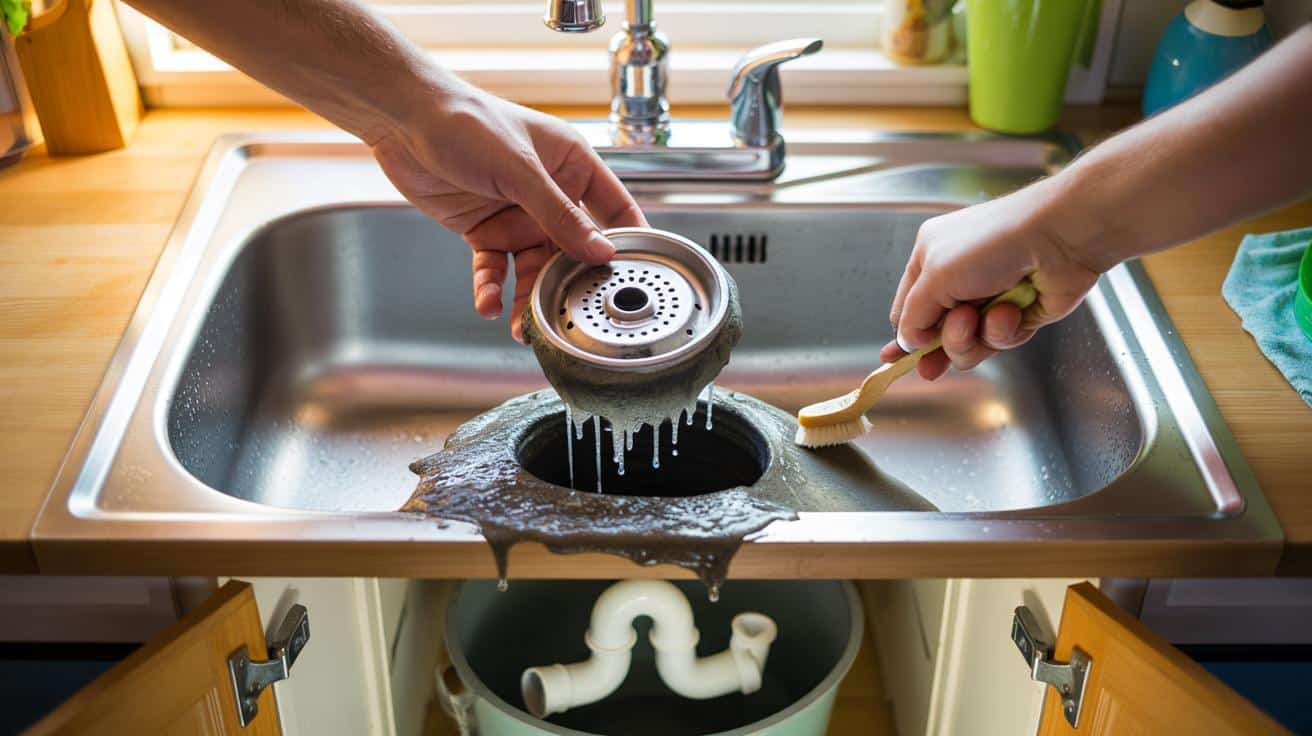
Start with the part you usually ignore: the drain itself. If your sink has a removable drain strainer, take it out completely. You might need to twist or gently pry it up. Rinse it under hot water, then scrub it with dish soap and an old toothbrush, especially around the rubber gasket.
Next, look at the ring around the opening — that narrow metal or plastic circle. Slide a thin cloth or sponge edge around it, as far as you can. You’ll be shocked by what comes up: black slime, orange biofilm, or that gray paste that smells like old mop water.
Then comes the slightly scary but satisfying part: clean the first section of the pipe. If you can, unscrew the top of the trap under the sink with your hands or a wrench, placing a bucket under it. Empty the gunk, rinse the pieces, scrub them, reassemble. That’s where the magic happens.
This is the step most of us skip, not because we’re lazy but because we’re slightly afraid of what we’ll find. We also tell ourselves the same thing: “If the water drains, it must be fine.”
Let’s be honest: nobody really does this every single day.
The trick is to build small, doable habits instead of heroic deep cleans twice a decade. Once you’ve done the big scrub, you can pour a kettle of hot (not boiling) water down the sink after greasy meals, or once at night. You can also wipe the drain ring quickly when you wipe the counter, like it’s just another surface.
Tiny gestures, repeated often, are much less terrifying than facing a black sludge monster once every three years.
Sometimes the worst smell in your kitchen isn’t a sign of dirt everywhere — it’s just one forgotten corner screaming for attention.
- Clean the visible drain parts weekly
Unscrew or lift out the strainer, scrub with dish soap and a small brush, and rinse with hot water. This keeps the top layer from becoming a crusted ring of grease. - Do a “trap check” every 2–3 months
Loosen the trap under the sink with a bucket underneath. Empty, rinse, and wash the parts with soapy water. *Yes, it’s a bit gross the first time, and then oddly satisfying.* - Use boiling water and products smartly
Boiling water alone helps melt fatty deposits. Baking soda and vinegar can freshen the pipe, but they don’t replace physical scrubbing of the gunk clinging to the walls. - Watch what you send down the sink
Coffee grounds, frying oil, heavy starches and peels tend to stick and rot. Wipe pans with paper before washing and toss the worst bits in the trash or compost. - Trust your nose early
A faint “wet dog” or musty smell is already a warning sign. The earlier you intervene, the less horror-movie your pipe will look when you finally open it.
Living with a sink you’re no longer afraid of
There’s something strangely calming about knowing exactly where a smell comes from. Once you’ve met the inside of your sink — really met it, face-to-sludge — the mystery disappears. You stop blaming the fridge, the trash, or some vague “old house smell”. You know where to look, and you know what to do.
The kitchen often feels like the emotional heart of a home, yet we rarely talk about the unglamorous pieces that keep it livable: traps, gaskets, those awkward pipes you bump with your knees when looking for a lost pan. When you clean that hidden part of the sink, you’re not just fighting bacteria, you’re reclaiming a space you use every single day.
Maybe that’s the quiet lesson here: most of what bothers us at home doesn’t come from big disasters, but from tiny, ignored corners.
And those are exactly the ones we can actually change.
| Key point | Detail | Value for the reader |
|---|---|---|
| Identify the real source of odors | Smell often comes from the drain flange and upper trap, not the visible sink | Stops endless, frustrating cleaning of the “wrong” areas |
| Use physical cleaning, not just products | Disassemble and scrub parts instead of relying only on baking soda or chemicals | Removes the actual sludge, not just masking odors temporarily |
| Create light, regular habits | Hot water flushes, quick wipe of the drain, periodic trap cleaning | Keeps smells away with minimal time and stress |
FAQ:
- Question 1Why does my sink still smell even after I pour baking soda and vinegar down the drain?
- Answer 1Those products can neutralize some odors and loosen light buildup, but they don’t replace actual scrubbing. If thick biofilm and grease cling to the drain walls or trap, only physical cleaning will fully remove the smell.
- Question 2Is it safe to unscrew the trap under my sink by myself?
- Answer 2Most household P-traps are designed to be removable by hand or with a basic wrench. Place a bucket underneath, go slowly, and don’t force anything. If the parts are corroded or stuck, it’s better to call a plumber than break a fitting.
- Question 3Can I just use bleach to kill the smell?
- Answer 3Bleach can kill bacteria and temporarily remove odor, but it doesn’t dissolve thick grease layers. It also shouldn’t be mixed with other chemicals like vinegar or drain cleaners. Cleaning the parts first and using mild products is safer and more effective.
- Question 4How often should I deep clean the hidden parts of my sink?
- Answer 4For a typical household, every 2–3 months is enough if you also use hot water flushes and avoid pouring oil down the drain. If you cook a lot with fats or have had recurring smells, monthly checks can help.
- Question 5What if the smell comes back quickly after cleaning?
- Answer 5If odors return within days, there might be a deeper issue: a partially clogged line further down, poor venting, or stagnant water in a rarely used branch of the plumbing. At that point, a professional inspection is worth it to avoid bigger blockages later.