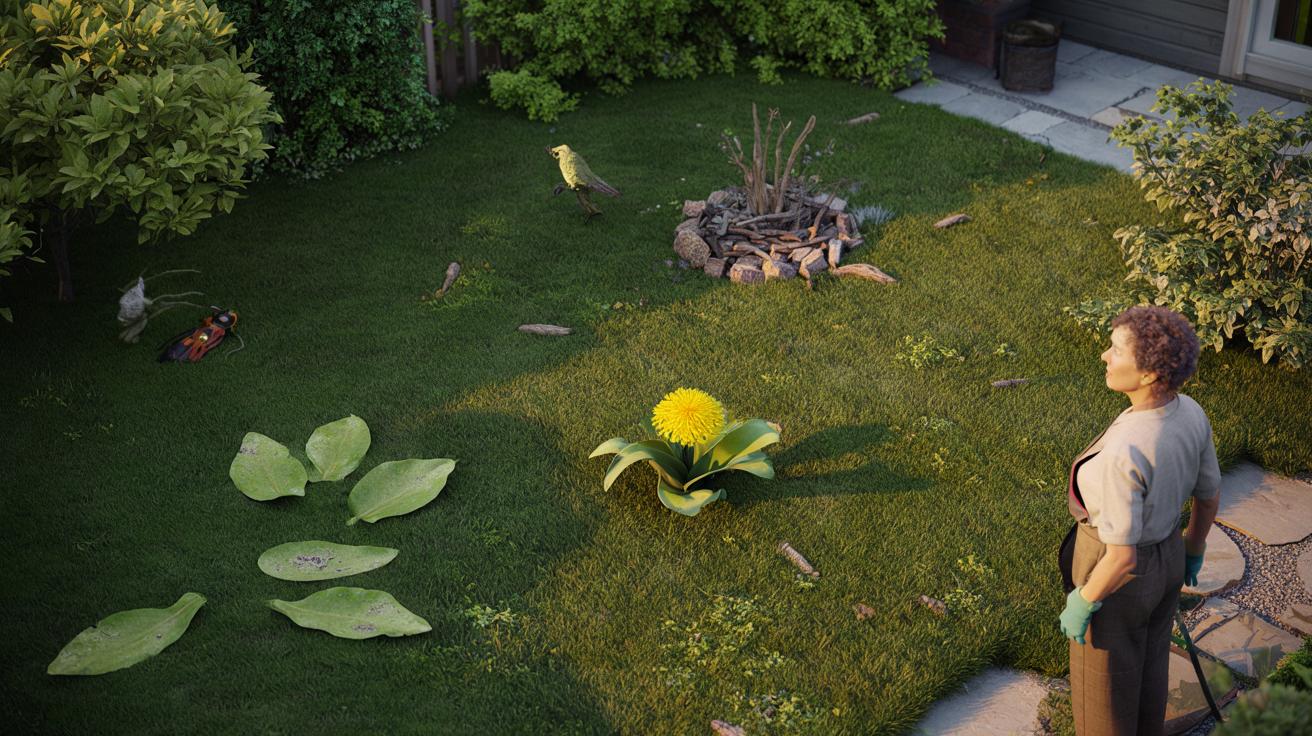
On a quiet Sunday morning, I watched my neighbor Marta step back from her flower beds and do something surprising. She spotted a crooked tulip, tilted its head in her hand… and simply left it that way. A dandelion glowed yellow between her paving stones. She glanced at it, half-smiled, and walked on. No rush for the trowel, no frantic weeding, no battle against every leaf out of line.
A week later, her garden looked healthier than mine, which I’d pruned and groomed to the millimeter.
That tiny, stubborn dandelion had drawn two bees and a ladybug while I stood there.
That’s when the thought landed: what if the small imperfections are exactly what save the garden?
Why imperfect gardens stay healthier over time
People who are new to gardening often dream of those magazine-ready borders. Perfect hostas, not a hole in a leaf. Lawns like green velvet. Beds free of any “wrong” plant. Yet the gardeners whose spaces quietly thrive year after year tend to do something else.
They leave a patch of soil bare. A corner a bit wild. A rose with a few black spots.
From the street, that garden might look less impressive. Up close, it’s alive in a deeper way.
Take Paul, a retired science teacher with a small town garden behind his semi-detached house. He used to spray, weed and clip until everything looked like a showroom. No bug allowed, no leaf out of place. By August each year, he’d end up with yellowing leaves, mystery diseases and a lawn that gave up at the first heatwave.
Five years ago, he stopped waging war. He left a pile of twigs in the corner, let clover creep into the lawn, and tolerated a few “wrong” plants at the base of his hedge. Slowly, the change showed. More birds, more pollinators, fewer outbreaks of mildew. His water use dropped, his plants recovered faster from storms, and he spent fewer evenings staring at gardening forums in panic.
The logic is almost embarrassingly simple. Ultra-neat gardens strip away the small things that protect plants over time. Every fallen leaf bagged, every weed sprayed, every insect treated like an enemy. That means less organic matter in the soil, fewer beneficial bugs, and a fragile balance that snaps with the slightest stress.
➡️ “I felt restless after sitting all day”: the signal I ignored for too long
➡️ If your body feels restless in the evening, this explains why
➡️ People who feel uneasy being taken care of often value independence deeply
➡️ The daily behaviors that keep your body in tension mode
➡️ This financial habit helped me feel in control even during uncertain months
➡️ This slow oven-baked dish fills the house with the most comforting smell
➡️ The cleaning habit that makes guests think your home is always tidy
➡️ The one cleaning task that makes all the others easier if you do it first
A slightly messy garden, on the other hand, builds its own defenses. Decaying leaves feed soil life. Tiny weeds shelter moisture. Predatory insects move in because there’s actually something to eat. *The garden becomes an ecosystem, not a showroom.*
What looks like a small imperfection today quietly prevents bigger problems later.
How to “garden with imperfections” without losing control
The trick is not to abandon your garden, but to give yourself permission to stop before everything is perfect. Start with one area: maybe a corner of your lawn, or the back of a flower bed. Decide that this patch is your “imperfect zone”. You’ll still tend it, but with a lighter touch.
Leave some fallen leaves under shrubs. Let groundcover plants spread a little more than feels comfortable. Don’t deadhead every single flower the moment it fades.
Watch how that small zone behaves over a season. You might be surprised by what quietly fixes itself.
Many gardeners confess the same thing: they know they’re overdoing it, but they can’t stop tidying. There’s a fear that if they let one weed stand, the whole place will collapse into chaos. That anxiety leads to endless raking, spraying and trimming, and honestly, exhaustion.
Let’s be honest: nobody really does this every single day.
Plants are far more resilient than we give them credit for. Killing every aphid can wipe out the ladybirds’ food source. Removing every self-sown seedling can block the next generation of strong, adapted plants. The art is to intervene where the garden really needs you, and deliberately ignore the rest.
Some experienced gardeners even have a saying for this: “If the problem is small enough to ignore, let nature solve it first.”
- Leave a few “clean” weeds like clover or violets in the lawn. They feed pollinators, fix nitrogen, and protect against bare patches.
- Keep a tiny pile of dead wood or stones at the back of a border. It becomes shelter for beetles, toads and solitary bees.
- Allow minor leaf damage on non-fragile plants. Chewed leaves are signs of a working food chain, not automatic failure.
- Stop cutting every edge razor-sharp. A softer border lets ground beetles, spiders and other allies move freely.
- Let some plants go to seed at the end of the season. They’ll self-sow, feed birds, and create natural succession without extra spending.
The quiet confidence of living with a “less perfect” garden
Once you start allowing small imperfections, the relationship with your garden subtly shifts. Instead of feeling like a permanent emergency, it becomes more of a conversation. A brown spot on the lawn is no longer a disaster; it’s a clue. A half-eaten leaf is not war; it’s a sign someone else is also living there.
You don’t have to love every weed or every insect. You just don’t need to fight each one as if the whole future of the garden depends on it.
There’s an odd freedom in walking past a crooked stem and deciding, consciously, to do nothing today.
| Key point | Detail | Value for the reader |
|---|---|---|
| Small imperfections build resilience | Leaving some leaves, weeds and minor damage supports soil life and beneficial insects | Fewer diseases, less watering, more robust plants over the years |
| Selective care beats constant control | Intervening only where plants truly struggle, not at every cosmetic flaw | Less work, less stress, better long-term results |
| “Wild corners” act as insurance | Dedicated areas left slightly messy create a refuge for helpers like ladybirds and spiders | Natural pest control and healthier ecosystems without extra products |
FAQ:
- Question 1Won’t leaving weeds ruin my whole garden?Not if you’re selective. Focus on removing truly invasive weeds that spread aggressively by roots or seeds, and tolerate a few low, non-invasive plants. A controlled amount of “weeds” can protect soil and support beneficial insects.
- Question 2Is it safe to leave dead leaves and twigs on the ground?Yes, in most cases. Leaves and small branches feed soil organisms and improve structure as they break down. Just avoid thick, wet mats right against delicate stems, and move anything diseased to the bin or a hot compost.
- Question 3What about pests if I stop being so strict?You’ll probably see more insects at first, but many will be harmless or helpful. As you allow a bit more diversity, predators like ladybirds, lacewings and birds show up and keep real pests from exploding out of control.
- Question 4How do I know when to act and when to ignore something?Look at the plant’s overall health. If new growth is strong and only a few leaves are damaged, wait and watch. If an entire plant is collapsing, or damage spreads fast across different species, that’s when more direct action is justified.
- Question 5Can an imperfect garden still look beautiful?Absolutely. Many of the most admired gardens mix tidy structure with relaxed details: trimmed paths with wilder borders, neat hedges with soft, self-seeded flowers. The eye reads it as alive, not neglected – and your plants quietly benefit from that breathing space.