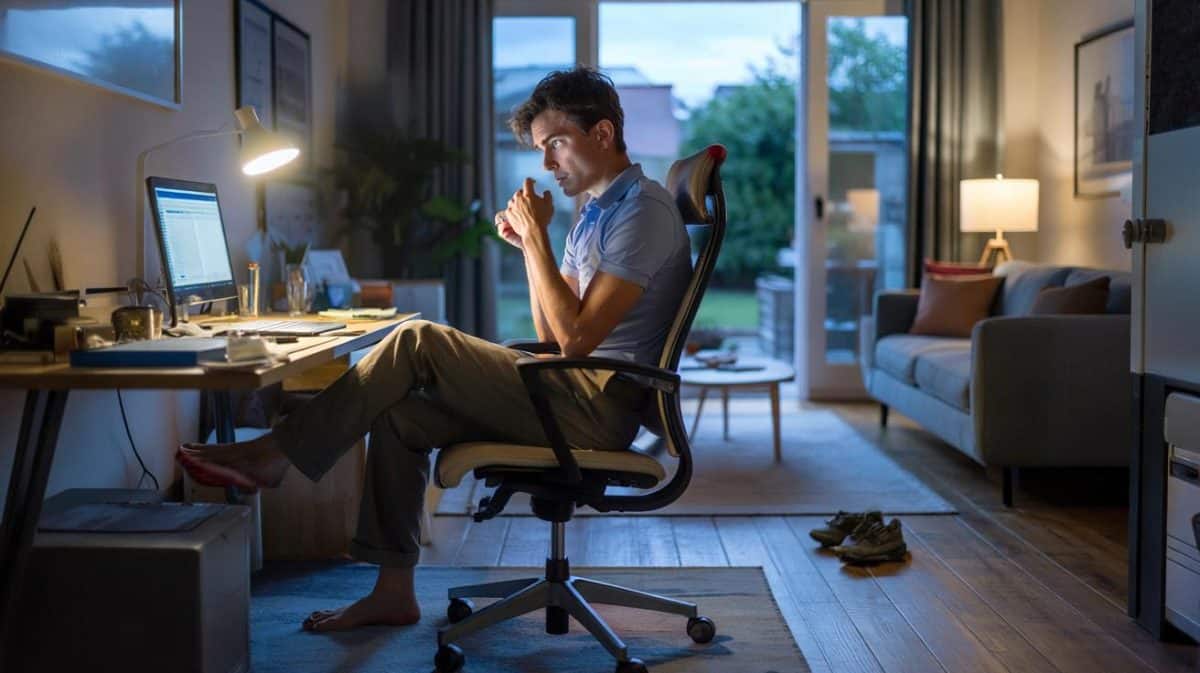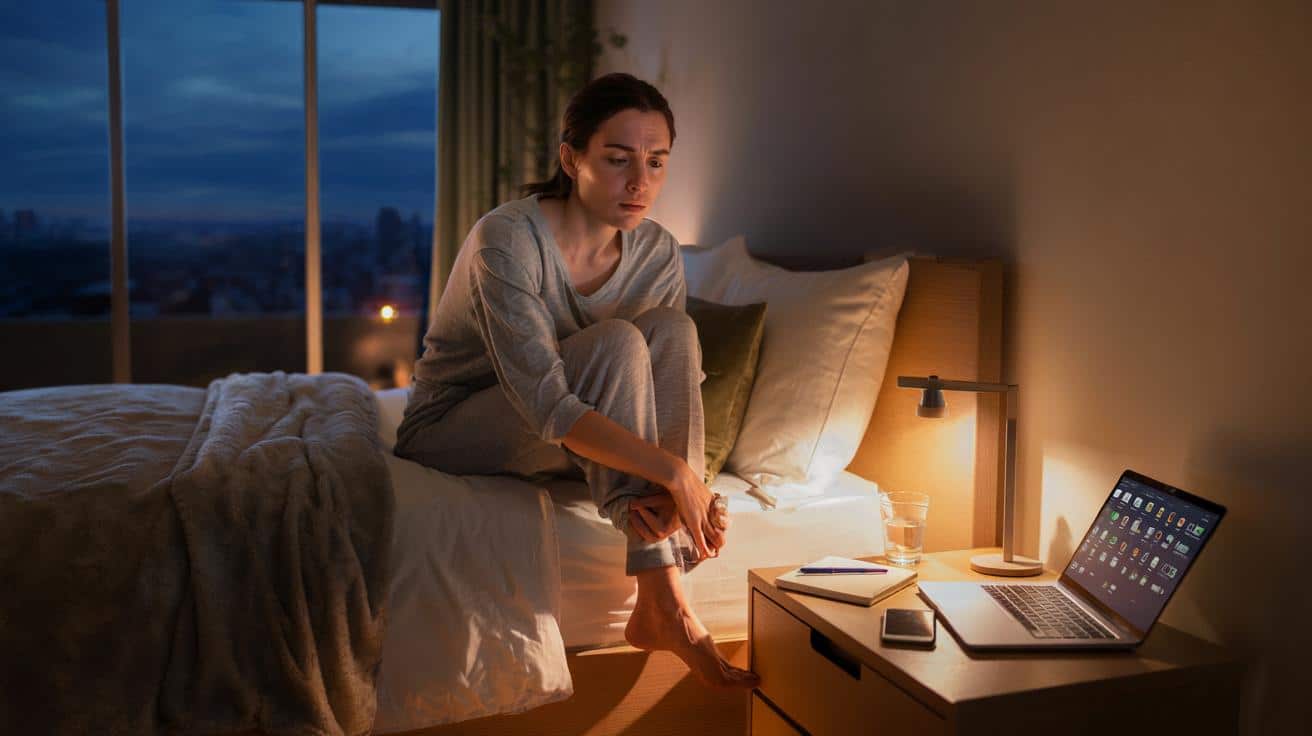
You know those evenings when your body feels like a shaken snow globe. The day is technically over, the lights are dim, you’ve changed into something soft, but your legs are buzzing, your chest feels wired, and your shoulders won’t unclench. You scroll, you yawn, but the inside of your body refuses to match the outside calm.
The clock creeps past 10 p.m., then 11 p.m. Your brain is begging for sleep, yet your muscles want to pace the hallway, rearrange the kitchen, run a marathon in the dark. You lie down, and your heart answers with a little drum solo. The question appears, as stubborn as the restlessness itself.
What exactly is your body trying to say?
When your body stays on “daytime mode” at night
There’s a strange dissonance when your body won’t power down even though the day is already done. Outside the window, everything is quiet. Inside your skin, it feels like rush hour. You’re not exactly anxious, not exactly full of energy either, more like a strange mix of tired and agitated.
Your legs twitch, fingers tap the mattress, jaw clenches for no good reason. You switch sides, change pillows, lower the light again, as if the problem were purely external. Yet the real story is often happening much deeper, somewhere between your nervous system, your hormones, and the way your day unfolded.
Think of a typical workday that bleeds into the evening. Messages coming in until late, a last email sent at 9:47 p.m., a quick look at social media “just to disconnect”. Your body spends hours in low-grade fight-or-flight mode. By the time you close your laptop, your brain is still scanning, predicting, reacting.
Then you move from intense screen light to sudden darkness in ten minutes flat. There’s no decompression, no slow landing, just a brutal attempt at shutdown. Your nervous system doesn’t speak “off switch”. It speaks transitions, signals, routines. When those are missing, restlessness steps in and fills the gap.
On a biological level, evening restlessness often has a very simple explanation. Cortisol, the stress hormone, hasn’t had time to drop. Melatonin, the sleep hormone, hasn’t had space to rise. Your digestion may still be working on that late dinner, your blood sugar may be doing tiny rollercoasters after a sweet dessert or a glass of wine.
Add artificial light that tricks your brain into thinking it’s still daytime, and you get a body convinced that it must stay alert. *Your body isn’t betraying you, it’s just answering the signals it receives.* When the signals say “day”, restlessness at night is almost logical.
Small shifts that tell your body “night has started”
One of the most effective ways to calm an evening-restless body is surprisingly modest. Start the “night sequence” earlier than you think you need it. Not a huge ritual, not a spa-level routine, just three or four repeated signals your body can learn over time.
➡️ This slow-cooked recipe turns time into flavor
➡️ “I work as a delivery planner, and this role pays much better than people imagine”
➡️ The cleaning habit that makes guests think your home is always tidy
➡️ “I couldn’t understand why my sink smelled until I cleaned this hidden part”
➡️ Why saving money feels easier once goals are clearly defined
➡️ “I felt restless after sitting all day”: the signal I ignored for too long
➡️ The daily behaviors that keep your body in tension mode
➡️ This financial habit helped me feel in control even during uncertain months
For example: lights dimmed around the same hour, a glass of water instead of a last coffee, phone left in another room, two or three stretches that you always do in that order. These gestures sound almost too simple. Yet repeated daily, they whisper to your nervous system: the race is over, you’re safe, you can land now.
Here’s a very concrete scene. Picture someone who gets home at 7:30 p.m., eats quickly, then collapses on the couch with Netflix and their phone in hand. The TV glows, the phone flashes, notifications pop up every few minutes. At 11 p.m., they turn everything off in a rush and walk directly to bed.
Their body has spent the whole evening absorbing blue light, fast images, emotional jolts from series and social feeds. That’s not “rest”. That’s stimulation in soft clothes. No wonder the body feels like a shaken can of soda when the lights finally go out. A 20-minute buffer without screens, even if it feels awkward at first, can transform that strange agitation into something softer.
There’s also the invisible part: the way we carry our day into our night. We replay conversations in our head, rethink emails, anticipate tomorrow’s problems. The body feels restless because the mind hasn’t finished its shift. A small trick some psychologists suggest is a “worry notebook” parked on the kitchen table.
You sit down, write everything spinning in your head, and deliberately tell yourself, “This belongs to tomorrow-me.” It sounds silly on paper, yet it creates a boundary. Your body likes boundaries. **When the mind is given a container, the muscles often let go a little.** Restlessness doesn’t disappear magically, but it finally has less fuel.
What really calms a wired body at night
One practical method that helps many restless bodies is a simple breathing pattern called 4-6. You inhale through your nose for 4 seconds, then exhale gently for 6 seconds. The longer exhale nudges your parasympathetic system, the “rest and digest” branch. No app needed, no equipment, just your lungs and some patience.
You can pair this with a tiny body scan. Starting from your toes, you silently name the part (“toes”, “calves”, “knees”) and let it soften a little on each exhale. It takes five, maybe seven minutes. Long enough for your pulse to drop a notch. Short enough to not feel like a chore before bed.
A common trap is trying to “fight” restlessness by forcing sleep. You close your eyes harder, change positions more often, check the time every 12 minutes, negotiate with your own brain. This usually backfires. The bed becomes a battlefield, associated with frustration instead of calm.
When your body is too restless to sleep, sometimes the kindest thing is to get up briefly. Low light, quiet activity: folding laundry, reading a paper book, sipping herbal tea. No screens, no big conversations, no bright kitchen lights. Give your body a neutral environment where it can slowly shift gears without pressure. Let’s be honest: nobody really does this every single day. Yet doing it even twice a week can slowly retrain your nights.
“Restlessness is often a healthy system reacting to an unhealthy rhythm,” explains one sleep therapist. “The body isn’t broken. The schedule is.”
- Dim lights one hour before bed
Switch from ceiling lights to lamps, reduce screen brightness, or use warm light bulbs. - Keep stimulants earlier in the day
Coffee and energy drinks in the morning or early afternoon only, not after 4 p.m. for most people. - Give your thoughts a parking spot
Use a notebook or notes app to “offload” worries before entering the bedroom. - Move a little, but not too late
Daytime walks or workouts help, high-intensity sessions at 10 p.m. often don’t. - Create a small night ritual you actually like
A stretch, a song, a book, a few minutes by the window. Something your body can look forward to.
Listening to what your evening restlessness is telling you
Evening restlessness can feel like a personal failure, as if you were the only one who can’t simply “relax”. Yet very often, it’s a message. A kind of physical highlighter pointing at the gap between the pace you live at and the way your body is built to function. Our biology still belongs to a world of sunsets and slow darkness. Our lives, not so much.
The challenge isn’t to become perfect sleepers. It’s to notice: when does your body start to resist, and what happened in the hours before. Maybe it’s three coffees and zero real breaks. Maybe it’s your only quiet moment of the day, and your mind refuses to give it up to sleep so quickly. Maybe your restlessness is loneliness in disguise, or unprocessed stress that hasn’t found words yet.
That buzzing feeling in your legs, that racing chest, that urge to scroll endlessly in the dark can be a starting point rather than just a problem. A prompt to adjust one element of your evening, then another. Lights, timing, screens, food, movement, thoughts. Not all at once, not perfectly, but with curiosity.
We’ve all been there, that moment when your body seems to say, “I can’t keep doing days like this and then pretend to switch off on command.” Sometimes the most radical thing you can do is listen. And, little by little, design nights that your body doesn’t have to fight.
| Key point | Detail | Value for the reader |
|---|---|---|
| Evening restlessness has physical roots | Stress hormones, blue light, late meals, and mental overload keep the body in alert mode | Reduces guilt and self-blame by framing agitation as a logical response, not a flaw |
| Small signals can shift the body into “night mode” | Dimmed lights, screen-free buffer, repeated micro-routines, worry notebook | Offers realistic changes that don’t require huge willpower or expensive tools |
| Gentle practices calm the nervous system | 4-6 breathing, light movement, getting out of bed briefly instead of forcing sleep | Provides concrete tools to experiment with tonight and feel a first difference |
FAQ:
- Is evening restlessness always a sign of anxiety?
Not always. It can come from stress, caffeine, lack of movement during the day, irregular sleep hours, or screen exposure. If it’s intense or linked to panic, a professional opinion is wise.- Could this be restless legs syndrome?
Possibly, if you feel an urge to move your legs, with weird sensations that ease when you walk. In that case, it’s worth speaking with a doctor, as there are specific treatments and tests.- Does exercising at night make restlessness worse?
High-intensity workouts late in the evening can keep some people wired. Calm yoga, stretching, or a slow walk tends to help. The key is to observe how your own body reacts.- How long does it take for new habits to help?
Some people feel a difference after a few nights of dimmed lights and regular bedtime. For others, it may take a few weeks for hormones and sleep pressure to rebalance.- When should I worry and seek medical advice?
If restlessness is severe, constant, accompanied by pain, heart palpitations, breathlessness, or deep insomnia over weeks, it’s time to talk with a doctor or sleep specialist.