The day my friends came over for dinner, my apartment looked like a magazine spread. Floors shining, cushions perfectly fluffed, candles lit in every room. I’d scrubbed the bathroom until it smelled faintly of bleach and eucalyptus. The kitchen counters were so clear they almost looked unfamiliar. I’d even alphabetized my spice rack, as if anyone on earth cares whether the cumin stands next to the coriander.
By the time the doorbell rang, I was exhausted but proud.
Two hours later, one of my guests opened her mouth, smiled, and said the sentence that made my stomach drop.
I’d forgotten the one thing guests really notice.
The invisible detail that screams “I didn’t really clean”
The house was clean, but my guests weren’t talking about the floors. They were talking about the smell. Not a terrible smell, just that faint mix of old cooking, detergent, and “lived-in” air that lingers when a place hasn’t been aired out.
I’d scrubbed every surface and yet the first comment I heard was, “Oh, you cooked something with garlic earlier, right?” I hadn’t. That was just my apartment’s default scent. *It hit me like a spotlight on a stain I hadn’t seen.*
That evening I understood a simple, embarrassing truth: people notice the air of your home before they notice the shine of your sink.
Think about the last time you walked into someone’s house and instantly clocked something. Maybe it was a faint pet smell. Maybe a damp, slightly sour bathroom scent. Maybe just that heavy, closed-window air that feels like a bus after a long day. You don’t always say anything, but your brain quietly files it under “clean” or “not quite”.
One study from the National Library of Medicine found that smell shapes our perception of spaces even more than visuals. A spotless home with stale air feels off. A slightly cluttered home with fresh, light scent feels welcoming.
Nobody told us this in school. We grew up with “clean your room” meaning fold your clothes, make your bed, wipe things down. No one added, “and let the air breathe.”
➡️ The daily behaviors that keep your body in tension mode
➡️ People who feel pressure to stay emotionally available often skip emotional recovery
➡️ This planting depth mistake silently limits root expansion in most home gardens
➡️ Over 65? This simple change in your evening routine can reduce nighttime anxiety
➡️ If your body feels restless in the evening, this explains why
➡️ “I work as a delivery planner, and this role pays much better than people imagine”
➡️ This is why doing “one more thing” often backfires
➡️ The hidden reason young plants struggle even when temperature and light seem perfect
There’s a logic to it. Our brains are wired to use smell as a safety radar: bad food, smoke, mold. So when someone steps into your home, their nose runs ahead of their eyes. Before they’ve registered your vacuum lines in the carpet, they’ve already judged the atmosphere.
Screens and social media don’t help. We see perfect homes on Instagram, all bright and spotless. What we don’t see is how they smell right after a stir-fry, a wet dog, or a week of closed windows.
Let’s be honest: nobody really does this every single day.
We clean what we see and forget what we breathe. Yet what we breathe is the first thing guests feel.
How to “clean the air” before guests arrive
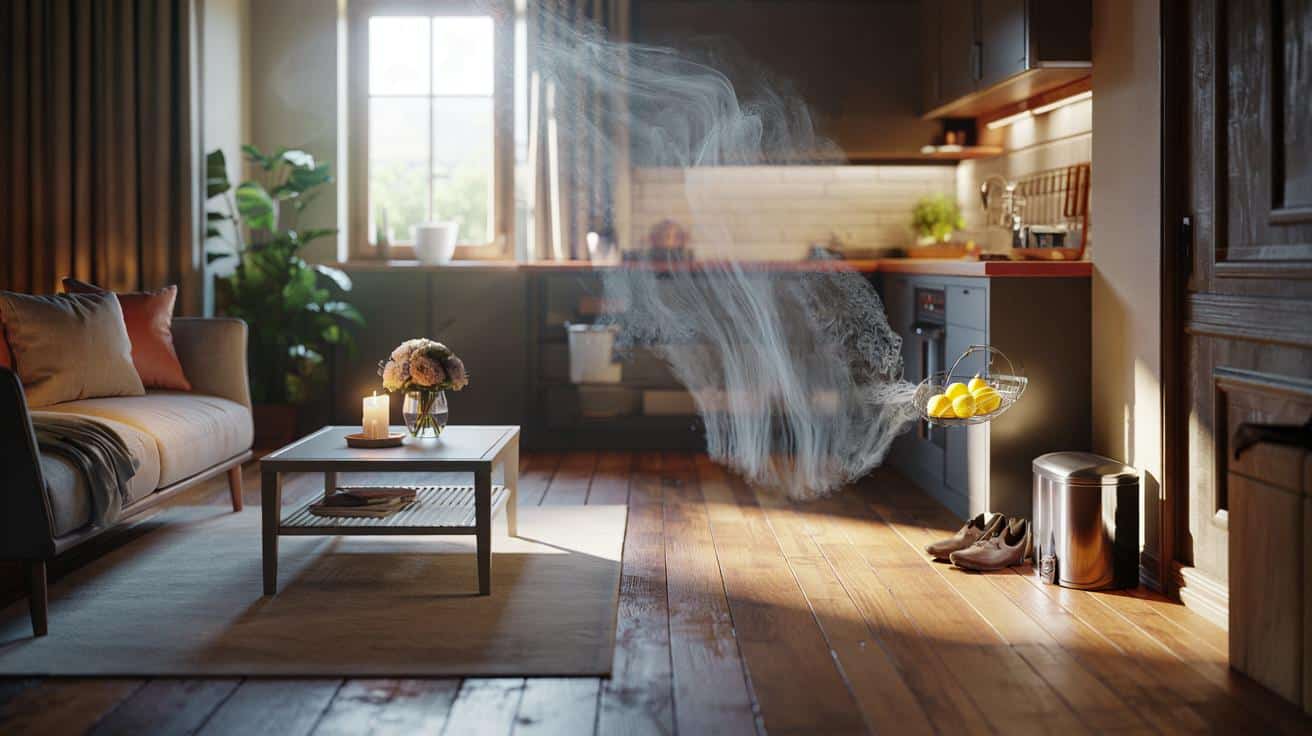
The trick isn’t to drown your home in artificial fragrance. The trick is to reset the air. The simplest move costs nothing: open windows wide, even for just ten minutes. Cross-ventilation — one window open in the living room, another in the kitchen or hallway — changes everything.
If you can, do it twice: once at the start of cleaning, once about 30 minutes before guests arrive. You’re not just refreshing the air, you’re clearing out cleaning-product fumes and lingering cooking smells.
Then, go to the quiet culprits: dishcloths, bathroom towels, bathmat, trash can. Swap, empty, or wash. A single damp towel can undo an entire deep clean.
Most of us respond to “house smell anxiety” with scented candles or room sprays. They help, but they can also create a weird layer of perfume over stale air. It’s like spraying deodorant without showering. Your nose knows.
Try this order instead: air out, neutralize, then add a gentle scent. Neutralizing can be as basic as putting a small bowl of baking soda in the kitchen or by the trash, or simmering a pot of water with lemon slices and a bay leaf.
One common mistake is overdoing the fragrance. A violently floral living room can feel as aggressive as a bad odor. Guests shouldn’t be able to taste your diffuser.
Sometimes, the kindest thing you can do for your home is to let it breathe like a person who’s been holding their breath all day.
- Open windows for 10–20 minutes
Create a quick draft to push out cooking, pet, or “closed room” smells. - Swap hidden fabric traps
Change dishcloths, hand towels, and the bathmat right before guests arrive. - Neutralize before you scent
Use baking soda, white vinegar in a bowl, or a simple lemon simmer to reset the air. - Choose one light scent point
A candle, a small diffuser, or a few drops of essential oil near the entrance, not in every single room. - Check the “nose-height” zones
Trash can lids, sofa blankets, cushions, and the entryway shoe area are tiny but powerful smell emitters.
What guests really remember when they leave your home
No one is going home thinking about the angle of your throw pillows. They’re remembering how they felt walking through your door. Relaxed or tense. At ease or on alert. A fresh, soft-smelling space quietly tells people: you’re safe here, you’re welcome here.
The irony is that the detail we forget — the air — is the one that wraps around everything else. Your clean sink, your tidy hallway, your folded blanket: they all live inside that invisible atmosphere. When the air is heavy or musty, even the most polished room feels like it’s hiding something.
There’s also a strange kind of kindness in tending to the air. Some guests are too polite to mention smells, some are sensitive, some carry their own insecurities about their homes. When they walk into a place that feels light and quietly cared for, it doesn’t just impress them. It reassures them.
We’ve all been there, that moment when we walk into someone’s house and instantly think, “Oh, this feels good.” We can’t always say why.
That “why” is often a cracked window, a fresh towel, and a host who thought beyond the visible.
Maybe that’s the real shift: stopping seeing cleaning as a performance and starting to see it as hospitality. Not perfection. Not a showroom. Just a lived-in space that breathes, like the people in it.
Next time you’re racing around before guests arrive, pause for a second. Look up from the floors and listen to the quiet air in your home.
What story is it telling, before you’ve even said hello?
| Key point | Detail | Value for the reader |
|---|---|---|
| Fresh air beats surface shine | Guests judge a home’s cleanliness first through smell and atmosphere | Helps prioritize what really shapes first impressions |
| Neutralize, then scent | Ventilate, tackle fabric traps, then add a light, single scent | Prevents heavy or artificial smells that feel fake or overwhelming |
| Small habits, big impact | Window time, fresh towels, clean trash area before visits | Simple routine that makes your home feel welcoming without extra stress |
FAQ:
- Question 1How long should I air out my home before guests arrive?
- Answer 1Ten to twenty minutes of real airflow — with at least two windows open — is usually enough to reset the air in most homes.
- Question 2What if I live on a noisy street and can’t leave windows open for long?
- Answer 2Do short, intense bursts: open widely for 5 minutes, close, wait, then repeat once if you can. Combine this with a fan to move air around inside.
- Question 3Are scented candles better than diffusers for guests?
- Answer 3Candles feel cozy, diffusers are steadier. The key is subtlety. Choose one light scent and keep it to one area, ideally near the entrance or living room.
- Question 4How do I deal with persistent pet odors?
- Answer 4Wash pet bedding often, vacuum soft furniture, and ventilate daily. Use baking soda on rugs and leave a bowl near litter boxes or pet corners before visits.
- Question 5My home smells “closed” even when clean — what else can I do?
- Answer 5Check hidden moisture sources: bathmats, shower curtains, damp towels, or crowded closets. Dry, declutter, and rotate fabrics, then ventilate regularly.