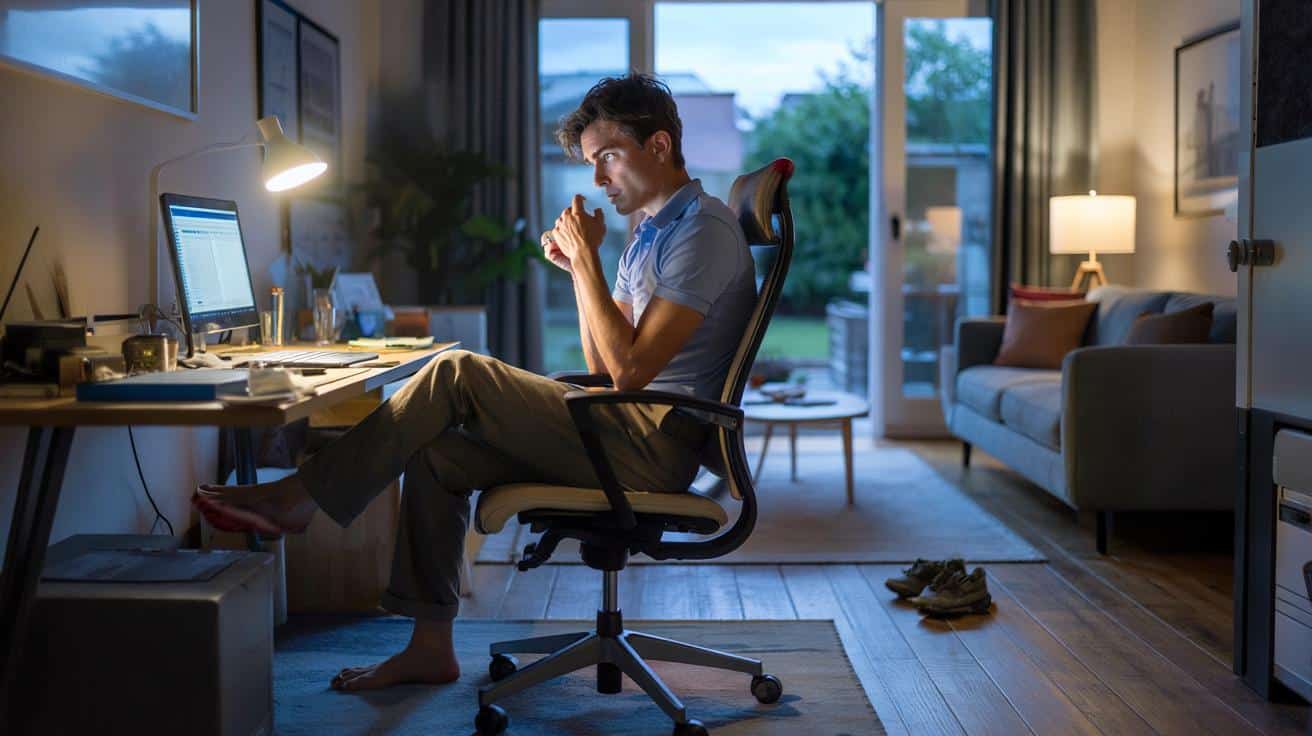
The first time I really noticed it, I was answering emails at 8 p.m., still frozen in the same chair I’d sat in since 9 that morning. My legs felt buzzy, like a phone on silent vibrate. My chest was tight for no clear reason. I kept shifting, crossing and uncrossing my legs, stretching my neck, tapping my foot under the desk like it had somewhere urgent to go.
Nothing was actually wrong in that moment. No crisis at work. No looming deadline. Just this low-grade internal hum, a weird blend of restlessness and exhaustion I couldn’t quite name.
I told myself it was just “one of those days”.
I was wrong.
The quiet kind of discomfort that doesn’t feel like a problem… at first
There’s a specific discomfort that comes from sitting all day that doesn’t scream, it whispers. Your body doesn’t collapse dramatically. It just starts sending tiny signals. A twitch in your calf. A shoulder that feels like stone. Eyes that burn even though you slept fine.
You shift in your seat for the tenth time and open a new tab. You scroll. You yawn. Maybe you grab another coffee. You tell yourself you’re just tired, that tomorrow will feel better.
That restless feeling after a long, static day? That was my body gently tapping on the glass, asking to be heard.
I remember one Tuesday in particular. I’d logged on at 8:30 a.m. and, except for one rushed trip to the kitchen, never really got up. At 5 p.m., I closed my laptop and stood. My knees felt rusty. My lower back ached in that dull, familiar way I’d started to call “normal”.
I tried to relax on the sofa, but my body wouldn’t settle. I kept adjusting my position, stretching my neck, rotating my ankles. My brain felt wired and oddly blank at the same time. So I did what so many of us do: grabbed my phone and started scrolling, convinced I was “resting”.
Forty-five minutes later, I was more drained, more irritable, and still restless. That was my new routine, disguised as downtime.
➡️ Over 65? This simple change in your evening routine can reduce nighttime anxiety
➡️ This slow-cooked recipe turns time into flavor
➡️ People who feel uneasy being taken care of often value independence deeply
➡️ “I cleaned my house thoroughly but forgot the one thing guests notice”
➡️ Why saving money feels easier once goals are clearly defined
➡️ This simple savory bake delivers deep flavor with minimal effort
➡️ This warm, filling recipe is perfect when the weather turns cold
➡️ This is why doing “one more thing” often backfires
Only later did I realise there was nothing mysterious about that edgy, unsettled state. Sitting for long periods slows blood flow, especially in the legs. Muscles shorten and stiffen. Your diaphragm gets compressed, your breathing gets shallow, your brain gets less oxygen.
On top of that, your nervous system quietly shifts into a mild stress mode. Heart rate slightly up, cortisol nudging higher, thoughts flickering faster. Your body is desperate for movement, but the brain misreads the signal as anxiety or mental fatigue.
So you push harder at the screen, thinking the problem is workload or willpower, when the real issue is that you haven’t stood up in three hours.
Small, unglamorous habits that change everything
The shift for me started with one simple, slightly annoying rule: no sitting longer than 45 minutes at a time. That was it. No fancy gadget, no gym membership, just a timer on my phone and a promise to actually obey it.
Every 45 minutes, I’d stand up. Walk to the window. Stretch my arms overhead. Roll my shoulders. Sometimes I’d just pace the hallway like someone waiting for a delivery. Two, three minutes. Then back to work.
It felt pointless the first week. By the third, my late-afternoon restlessness was noticeably softer. My legs didn’t buzz as much. My brain didn’t feel like static.
The hardest part wasn’t the standing. It was the guilt. I’d stand up and instantly feel like I was “wasting time”. I’d hear that little inner manager voice: You’re busy, sit down, finish this email, then move.
That voice had kept me stuck for years. So I started reframing those micro-breaks as part of the job, not a break from it. A reset for my concentration. A kind of maintenance. Because when I skipped them, my 4 p.m. self was slower, snappier, and far more likely to reread the same sentence three times.
Let’s be honest: nobody really does this every single day. I still fall into three-hour sitting marathons. The difference now is that I notice the crash sooner and I know exactly why it’s happening.
One thing a physiotherapist said to me finally clicked everything into place.
“Your body isn’t mad at you for sitting,” she told me. “It’s mad at you for not moving after you sit.”
That sentence lives rent-free in my head.
Here’s what actually helps me when the restlessness hits hardest:
- Stand up every 45–60 minutes, even if it’s just to walk to the sink and back.
- Do 5 slow breaths with one hand on your belly to reset your nervous system.
- Stretch hip flexors and chest for 30 seconds each to undo the “desk hunch”.
- Use phone calls as “walking meetings” whenever possible.
- At the end of the workday, take a 10-minute walk before touching the sofa or your phone.
*It’s not heroic or aesthetic or Instagram-worthy – it’s just the boring kind of consistency our bodies quietly crave.*
Listening to the signal before it turns into a shout
The thing about that post-sitting restlessness is that it rarely shows up alone. Over time, it brings friends: sleep that doesn’t refresh, headaches that float in mid-afternoon, a mood that lives in the grey zone.
You don’t wake up one day with a “sitting problem”. It’s thousands of small days where your body says, “Can we move?” and you say, “Later.” You get used to feeling off. You forget what clear-headed actually feels like.
The signal I ignored the longest wasn’t the backache or the tight hips. It was that constant sense of being wired and tired at the same time.
Once I started treating that restless feeling as data instead of drama, things shifted. On days when it spiked, I’d look back and almost always find the same pattern: back-to-back calls, lunch at my desk, zero real breaks. No wonder my body was buzzing like a trapped fly.
So now, when that edgy energy shows up, I ask a different question. Not “What’s wrong with me?” but “How long have I been still?” Sometimes the answer is embarrassing. Three hours. Four.
That simple check-in doesn’t magically fix anything. It just stops me from telling myself the old story that I’m lazy or unmotivated. Usually I just need to stand up and move my actual legs.
Maybe you recognise some version of this in your own day. The long commute, the office chair, the sofa that swallows your evenings. The sense that your body wants something you’re too tired to give.
The restlessness after sitting all day is not a character flaw or a mystery symptom. It’s a message from a body designed for walking, bending, reaching, carrying, and yes, sometimes just standing by a window for a minute and looking at nothing in particular.
The question isn’t whether your body is sending signals. It’s how long you’re willing to ignore them before they get louder than your to-do list.
| Key point | Detail | Value for the reader |
|---|---|---|
| Micro-movements matter | Short, frequent breaks (2–3 minutes every 45–60 minutes) ease restlessness more than one big workout | Makes change feel realistic on a busy day |
| Restlessness is data | That “wired and tired” feeling often comes from long, uninterrupted sitting | Helps reduce guilt and self-blame |
| End-of-day reset | A 10-minute walk or stretch routine before the sofa or phone | Improves sleep, mood, and sense of closure after work |
FAQ:
- Why do I feel more tired on days when I barely move?Your body is built to spend energy through movement. Long sitting reduces circulation and oxygen to your brain and muscles, which can make you feel sluggish, foggy, and strangely exhausted even if you didn’t “do” much.
- Is a daily workout enough to offset sitting all day?Regular exercise helps, but if you sit 8–10 hours straight, one workout won’t fully undo the effects. Think “movement snacks” throughout the day, plus workouts, rather than choosing one or the other.
- How often should I stand up during work?A realistic target is every 45–60 minutes. Even 2–3 minutes of standing, stretching, or walking around the room helps reset blood flow and calm that restless edge.
- What if my job doesn’t allow many breaks?Look for tiny pockets: standing during a phone call, walking to speak to a colleague instead of messaging, stretching while a file loads, doing ankle circles under the desk. Small things compound over weeks.
- How do I unwind without just collapsing on the sofa?Try a short “transition ritual” after work: a 10-minute walk, a shower, or gentle stretching. That small reset usually makes the actual sofa time feel more restful and less like a numb scroll.