The smell arrived before the sound.
You know the one: a low, quiet house, early evening, and suddenly the air shifts. Something warm, savory, almost sweet, curls out of the kitchen and slips down the hallway like a promise. Jackets end up on chairs instead of hangers. Phones go face down. Even the dog lifts its head, sniffing with slow recognition.
On the stove, almost nothing seems to be happening. The oven door is closed, the timer is hours away, yet the entire home feels different. Softer. Safer. Hungrier.
Some dishes you look at.
This one, you feel.
The slow-baked magic that turns a house into a home
There’s a particular kind of oven-baked dish that doesn’t shout, it murmurs.
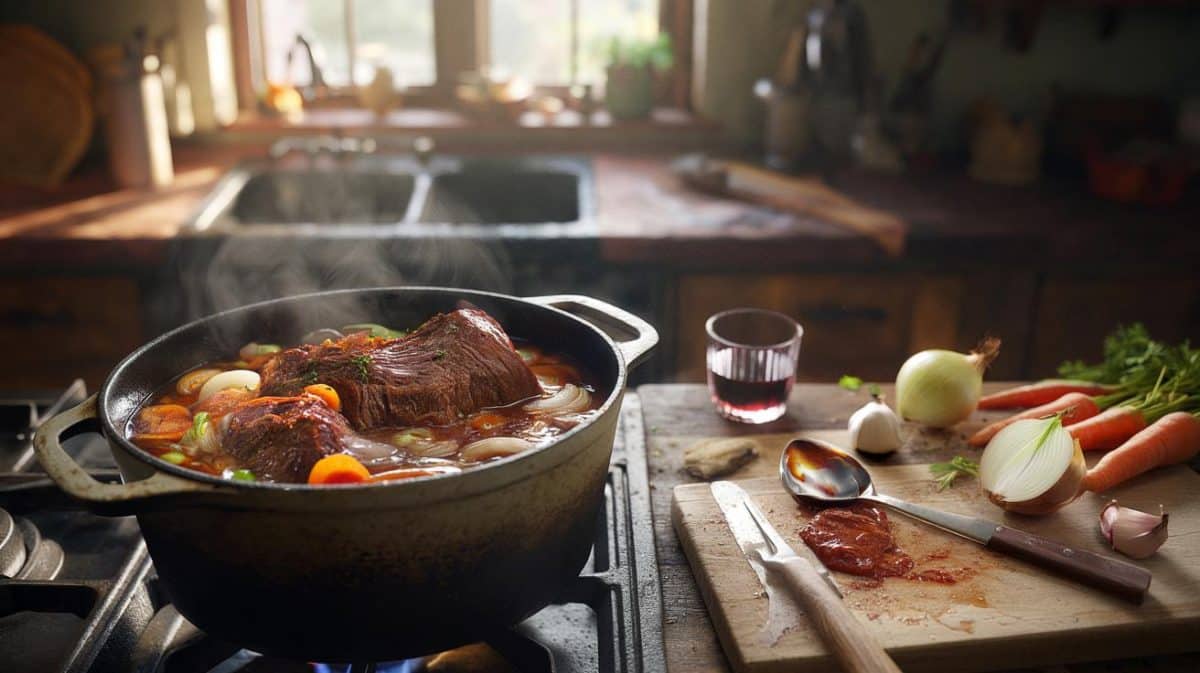
It’s not a showy roast that goes from raw to ready in 45 minutes. It’s the one that settles in for the long haul: a slow-baked beef and red wine stew, tucked into a heavy pot, forgotten and then remembered every time someone walks through the kitchen.
The meat barely moves, the sauce only trembles at the edges, yet the aroma thickens by the minute.
Onions, garlic, thyme, maybe a bay leaf or two. A splash of wine that smells sharp at first, then rounds off into something deeper and almost nostalgic.
By the time it’s done, it doesn’t just smell like dinner. It smells like someone cared.
Picture a grey Sunday where the sky never fully wakes up.
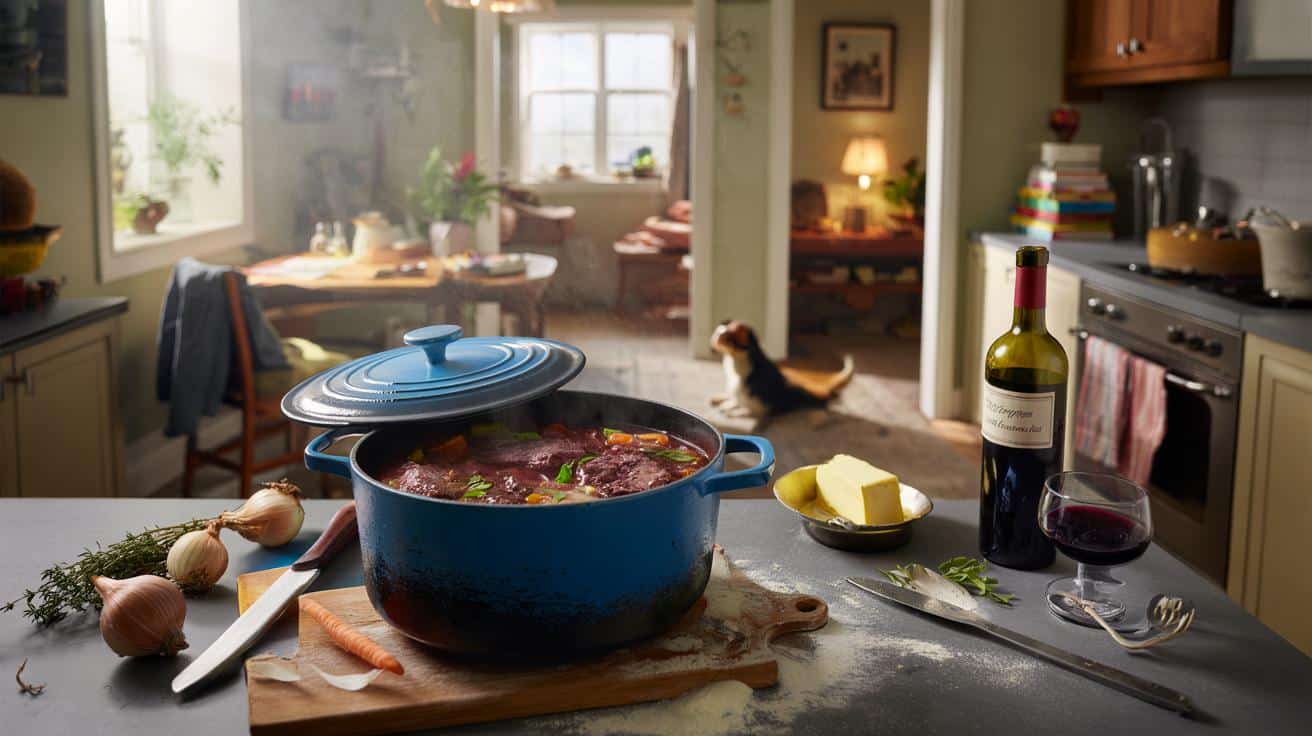
A parent in thick socks pads into the kitchen before anyone else stirs, slices onions with that sleepy, automatic rhythm, browns cubes of beef until they catch just a bit on the pan. Flour dusts the counter, a stray carrot peel sticks to the cutting board.
They deglaze with wine, scrape up all the stuck bits, add stock, herbs, a clove or two of garlic. Everything gets transferred to a heavy casserole dish and pushed into a low oven, door closed with a gentle thud.
Then life continues: laundry, homework, scrolling, arguments about who lost the remote.
Hours go by. No one really watches the clock.
But every time someone crosses the hallway, they slow down and breathe in, like the house itself is exhaling comfort.
There’s a simple reason this kind of dish fills the whole home, not just the kitchen.
Slow baking gives aromas time to bloom and spread. At low heat, the fat renders gently, the collagen in the meat breaks down, and vegetables caramelize in slow motion. All those flavor molecules get carried by the warm air and drift into every room.
Quick dinners don’t behave this way. They flash, they sizzle, they’re fun, then they vanish.
A stew that’s been in the oven for three, four, even five hours sends up a continuous signal: “Something good is coming. Be patient.”
➡️ This simple savory bake delivers deep flavor with minimal effort
➡️ “I felt restless after sitting all day”: the signal I ignored for too long
➡️ Gardeners who leave small imperfections see fewer long-term problems
➡️ The hidden reason young plants struggle even when temperature and light seem perfect
➡️ “I couldn’t understand why my sink smelled until I cleaned this hidden part”
➡️ If your body feels restless in the evening, this explains why
➡️ The cleaning habit that makes guests think your home is always tidy
➡️ This is why doing “one more thing” often backfires
That’s why these dishes feel emotional.
They’re not just about hunger; they’re about anticipation.
How to build that “my whole house smells amazing” stew
Start with the onions.
If there’s one quiet rule of slow oven dishes, it’s this: long-cooked onions are the foundation of that impossible-to-resist smell. Slice two or three big ones, throw them into a heavy pot with a good glug of oil or butter, and let them go low and slow until they’re soft and golden around the edges.
Then add your beef, cut into rough chunks, not too small. Let it brown in batches so it actually sears instead of steaming.
Stir in garlic, tomato paste, a spoon of flour, and let it all catch slightly on the bottom. That “almost burnt” fragrance? That’s flavor building itself.
Only then pour in red wine and beef stock, scrape, and transfer to the oven at a gentle 150–160°C (300–320°F).
Most people rush this dish at the exact wrong moment: the start.
They toss raw meat, raw veg, and liquid into a dish, cover it, and hope the oven fixes everything. The result might be fine, but it rarely has that deep, lingering aroma that feels like walking into a countryside inn.
Another common trap is going too hot, too fast. Cranking the oven to 200°C just means tough meat and a dried-out top. Then there’s the lid issue: fully sealed and you risk a flat, muted scent; completely uncovered and the sauce shrivels into a sticky puddle.
Aim for something in between.
Lid on, but slightly ajar.
Low heat, long time. *Let the house fill up slowly instead of chasing instant gratification.*
“Every time I make this stew, my kids start drifting into the kitchen about an hour before it’s ready,” laughs Emma, a 42-year-old nurse who swears by her chipped blue Dutch oven. “They always ask the same question: ‘Is it done yet?’ I think half the comfort is in that waiting.”
- Key ingredients
Onions, garlic, beef chuck, carrots, celery, tomato paste, red wine, beef stock, thyme, bay leaves, a little smoked paprika. - Slow method
Brown the meat, caramelize the vegetables, deglaze, then cover and bake for 3–4 hours at low heat until the meat falls apart. - Little upgrades
A rind of Parmesan slipped into the pot, a splash of balsamic at the end, or a handful of fresh parsley right before serving. - Serving ideas
Spoon it over mashed potatoes, buttered noodles, crusty bread, or simply straight from the bowl with a spoon, sitting on the couch. - Next-day bonus
Tastes even better reheated, and the smell when you warm it up on Monday night might save your entire week.
Why this kind of dish feels like a memory waiting to happen
There’s a reason so many childhood food memories start with, “I remember the smell…”
Slow oven dishes have this peculiar ability to stretch time. While they bubble and thicken out of sight, life keeps happening around them. Kids argue over board games. Someone folds towels on the couch. Emails ping, the dog barks at nothing, the day wears on.
Through all of it, that smell stays steady.
It’s like background music, only tastier. It wraps everything that happens in the house with a soft, invisible thread, so later you remember them together: the stew, the laughter, the quiet, the weather outside.
Let’s be honest: nobody really cooks like this every single day.
Most evenings are a rush of frozen pizza, scrambled eggs, or a quick stir-fry grabbed between work calls and bedtime routines. That’s real life, and there’s no shame in it.
Maybe that’s why a slow-baked dish feels like such a luxury. Not the fancy-restaurant kind, but the emotional kind.
It signals that today, just for once, time is allowed to stretch. The oven hums gently, the house warms up, and for a few hours, dinner looks after itself.
You can step away, wander off, get lost in something else.
The pot is quietly doing the caring in the background.
On social media, these dishes keep going viral because people aren’t only chasing recipes; they’re chasing a feeling.
That moment when you open the oven and a wave of scent rolls out, fogging your glasses. The little silence at the table as everyone takes the first bite. The scraped-clean bowls stacked in the sink, proof of success even if the kitchen looks like a mild disaster.
This isn’t about perfect plating or exact measurements.
It’s about the kind of food that forgives you for being distracted, tired, slightly chaotic.
You toss everything into a pot with decent intentions and a bit of care.
The oven, over hours, turns it into something you’d happily call love.
| Key point | Detail | Value for the reader |
|---|---|---|
| Low and slow cooking | Bake at 150–160°C for several hours in a heavy pot, lid slightly ajar | Achieves deep flavor, tender meat, and that all-over-the-house aroma |
| Layering flavor at the start | Carmelize onions, brown meat, toast tomato paste and flour before adding liquid | Turns simple ingredients into a rich, comforting dish that tastes restaurant-level |
| Emotional payoff | Dish cooks quietly in the background while life happens around it | Creates memories, anchors lazy weekends, and brings everyone to the table |
FAQ:
- What cut of beef works best for a slow oven stew?Go for tougher, well-marbled cuts like chuck, blade, or shin. They look less glamorous raw but turn silky and spoon-tender after a few hours in the oven.
- Can I make this without wine?Yes. Replace wine with extra stock and a teaspoon of vinegar or a splash of Worcestershire sauce to bring back some of the depth and acidity.
- How long should I really bake it?Plan for at least 2.5 to 3 hours, and closer to 4 if your chunks are large. The dish is ready when the meat falls apart easily with a fork, not when the clock says so.
- Do I need a Dutch oven, or will any dish do?A heavy, lidded pot like a Dutch oven works best for even heat and moisture retention, but a deep baking dish tightly covered with foil can still give good results.
- Can I prepare it ahead of time?Absolutely. This kind of stew is almost better the next day. Chill it overnight, skim any excess fat, reheat gently, and enjoy an even richer flavor and another round of that incredible smell.